








En Plein Air Painting

"When I go out into the countryside and see the sun and the green and everything flowering, I say to myself "Yes indeed, all that belongs to me!"" — Henri-Julien-Felix Rousseau
en plein air
- French for "in the open air," used chiefly to describe paintings that
have been executed outdoors in the fields of nature, rather than in the
studio. Plein air painting was taken up by the English painters Richard
Parks Bonington (1802-1828) and John Constable (1776-1837), and the
French Barbizon School, and it became central to Impressionism.
Its popularity was aided by the development of easily portable painting
equipment and materials, including paints sold in tubes. The equivalent
term in Italian is "alfresco," which is also used by English-speakers.
(pr. pleh-nayr')
Using Nature as one's studio is not for every
artist. For me it brings a special contentment. It also
places me directly within my subject where I can see, feel and smell it
in all its natural beauty as nature created it.
It requires carrying my supplies and
equipment to where I want to paint, usually not too far from my mobile
studio. It allows me the ability to see features and details
within the shadow areas and highlights and color changes that may only
last seconds, things that only nature can provide.
Impressionism
- An art movement and style of painting that started in France during
the 1860s. Impressionist artists tried to paint candid glimpses of their
subjects showing the effects of sunlight on things at different times of
day. The leaders of this movement were: Camille Pissarro (French,
1830-1903), Edgar Degas (French, 1834-1917), Claude Monet (French,
1840-1926), and Pierre Renoir (French, 1841-1919). Some of the early
work of Paul Cézanne (French, 1839-1906) fits into this style.
Examples of Paintings painted "en plein air":
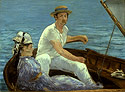
 Édouard
Manet (French, 1832-1883), Boating, 1874, oil on canvas, 38 1/4 x
51 1/4 inches (97.2 x 130.2 cm), Metropolitan Museum of Art, NY.
Édouard
Manet (French, 1832-1883), Boating, 1874, oil on canvas, 38 1/4 x
51 1/4 inches (97.2 x 130.2 cm), Metropolitan Museum of Art, NY.
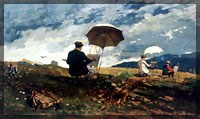
 Winslow
Homer (American, 1836-1910), Artists Sketching in the White Mountains,
1868, oil on wood panel, 9 7/16 x 15 13/16 inches, Portland Art Museum,
OR.
Winslow
Homer (American, 1836-1910), Artists Sketching in the White Mountains,
1868, oil on wood panel, 9 7/16 x 15 13/16 inches, Portland Art Museum,
OR.
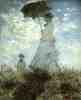
Claude
Monet (French, 1840-1926), Woman with a Parasol-- Madame Monet
[Camille] and her Son (La Promenade. La Femme à l'Ombrelle), oil on
canvas, 100 x 81 cm, 1875.
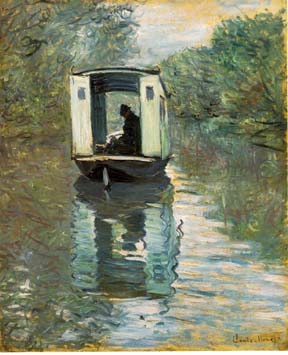
 Claude
Monet, The Boat Studio (Le bateau atelier), 1876, oil on canvas,
28 3/8 x 23 1/2 inches, Barnes Foundation, Merion, Pennsylvania
Claude
Monet, The Boat Studio (Le bateau atelier), 1876, oil on canvas,
28 3/8 x 23 1/2 inches, Barnes Foundation, Merion, Pennsylvania
.
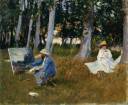
John
Singer Sargent (American, 1856-1925), Claude Monet Painting by the
Edge of a Wood, c. 1885, oil on canvas, 54.0 x 64.8 cm, Tate
Gallery, London. Although not usually considered an Impressionist,
Sargent was enthusiastic about painting en plein air, as he did
this portrait of his friend, Impressionist painter
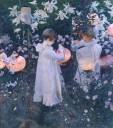
John
Singer Sargent, Carnation, Lily, Lily, Rose, 1885-6, oil on
canvas, 174.0 x 153.7 cm, Tate Gallery, London. Sargent painted this
picture out of doors during a very brief period each evening when the
light was at the same level, just after sunset (a time and kind of light
called crepuscular). This procedure was explored by many Impressionist
painters, and by Claude Monet most notably.
Web Design by: Felix A. (Tony) Grigsby ~ The Traveling Artist ~ Copyright © All rights reserved ~ Revised: .

the.artist.tony@gmail. com